Shareable Image
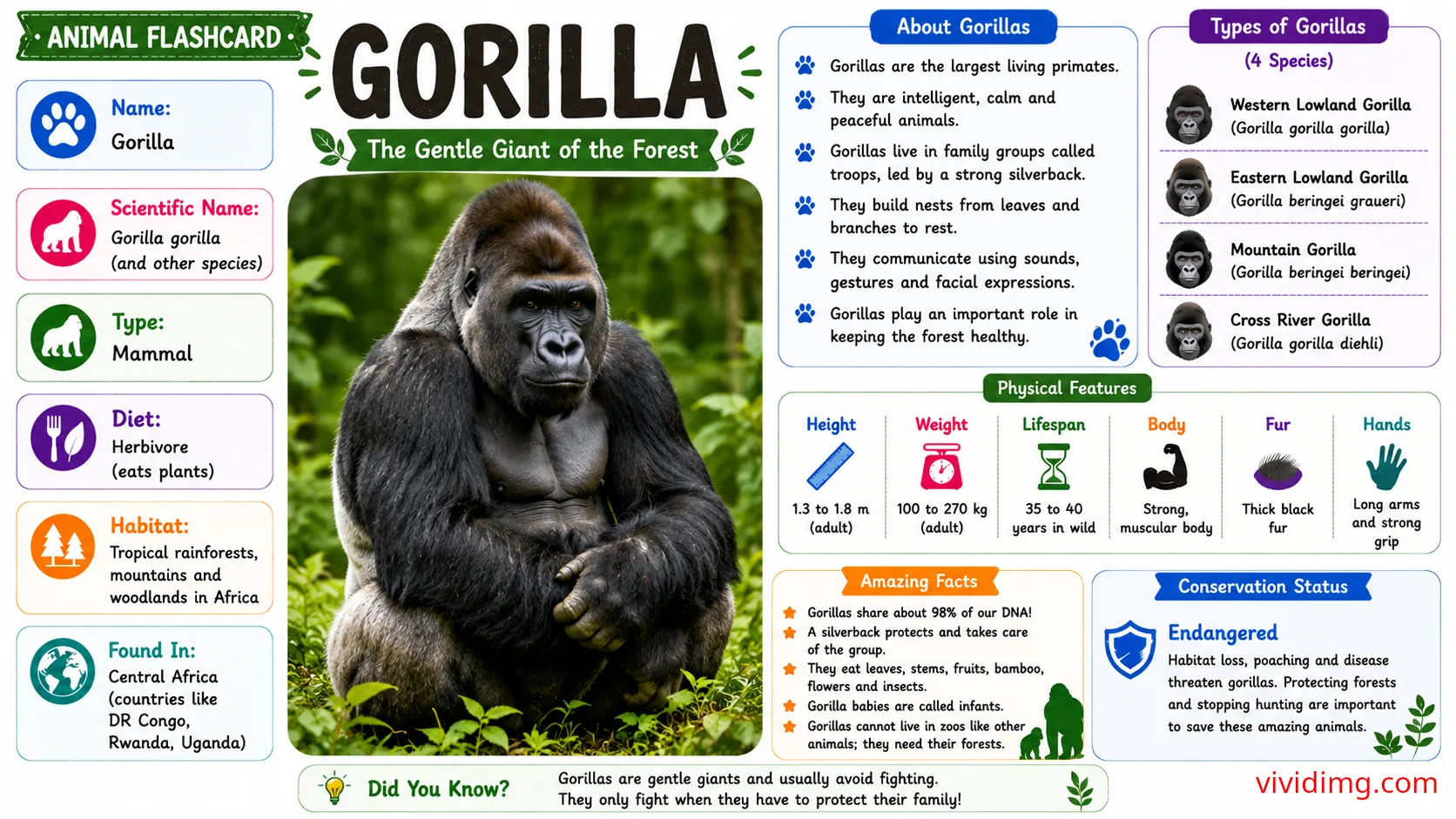
Gorilla facts for kids - Animal flashcard
Step into the fascinating world of gorillas with this engaging educational animal flashcard created for children, students, teachers, and wildlife enthusiasts. Gorillas are the largest living primates on Earth and are among the closest relatives of humans, sharing approximately 98% of our DNA. These remarkable mammals belong to the genus Gorilla and naturally inhabit the tropical rainforests and mountain forests of Central Africa. Despite their enormous size and powerful appearance, gorillas are generally peaceful, intelligent, and highly social animals. They spend much of their day feeding, resting, grooming, and interacting with members of their family group. Their diet mainly consists of leaves, stems, shoots, fruits, bamboo, and other plant materials, making them primarily herbivores. This educational flashcard introduces children to the gorilla's classification, habitat, physical characteristics, behavior, diet, family life, and conservation through an attractive visual format that encourages curiosity and learning.
A gorilla's body is perfectly adapted for life in dense forests. It has broad shoulders, long muscular arms, strong hands, and powerful jaws capable of chewing tough vegetation. Gorillas usually move using a style called knuckle-walking, where they support themselves on the knuckles of their hands instead of their palms. Adult male gorillas develop a patch of silver-colored hair across their backs as they mature, earning them the name 'silverback.' A silverback is the leader and protector of the family group, making important decisions about movement, feeding areas, and the safety of every member. Gorillas have expressive faces and communicate through facial expressions, gestures, vocal sounds, chest beating, and body posture. Contrary to popular belief, chest beating is not always a sign of aggression. It is often used to communicate strength, establish identity, or warn potential rivals without needing to fight. Their intelligence allows them to solve problems, recognize individuals, use simple tools, and learn from observation, making them one of the most fascinating animals in the primate family.
There are four recognized gorilla subspecies: the Western Lowland Gorilla, Cross River Gorilla, Eastern Lowland Gorilla (Grauer's Gorilla), and Mountain Gorilla. Each lives in different habitats across Central Africa and has unique characteristics adapted to its environment. Gorillas live together in family groups called troops, which usually include one dominant silverback, several adult females, their young, and sometimes younger males. Baby gorillas are called infants and depend completely on their mothers during the first years of life. As they grow, young gorillas spend much of their time playing, climbing, and learning important social skills from older members of the troop. Gorillas build sleeping nests every evening using leaves, branches, and vegetation, creating a fresh nest each night. These daily behaviors help children understand how animals adapt to their surroundings and maintain strong family bonds within the wild.
Although gorillas are among the strongest animals on Earth, they face many threats in their natural habitats. Habitat destruction caused by logging, mining, agriculture, and expanding human settlements continues to reduce the forests they depend upon. Illegal hunting, disease outbreaks such as Ebola, and conflicts with humans have also contributed to declining populations. Several gorilla subspecies are listed as Critically Endangered or Endangered by the International Union for Conservation of Nature (IUCN). Conservation organizations work closely with local communities to protect forests, prevent poaching, support scientific research, and promote eco-tourism that benefits both wildlife and people. This gorilla flashcard is an excellent educational resource for preschool and kindergarten learning, primary school science lessons, homeschooling, classroom projects, wildlife education, zoo studies, rainforest topics, and general knowledge activities. By combining realistic imagery with informative facts about anatomy, intelligence, behavior, habitat, and conservation, this flashcard helps children appreciate one of the world's most extraordinary primates while inspiring respect for biodiversity and wildlife conservation.