Shareable Image
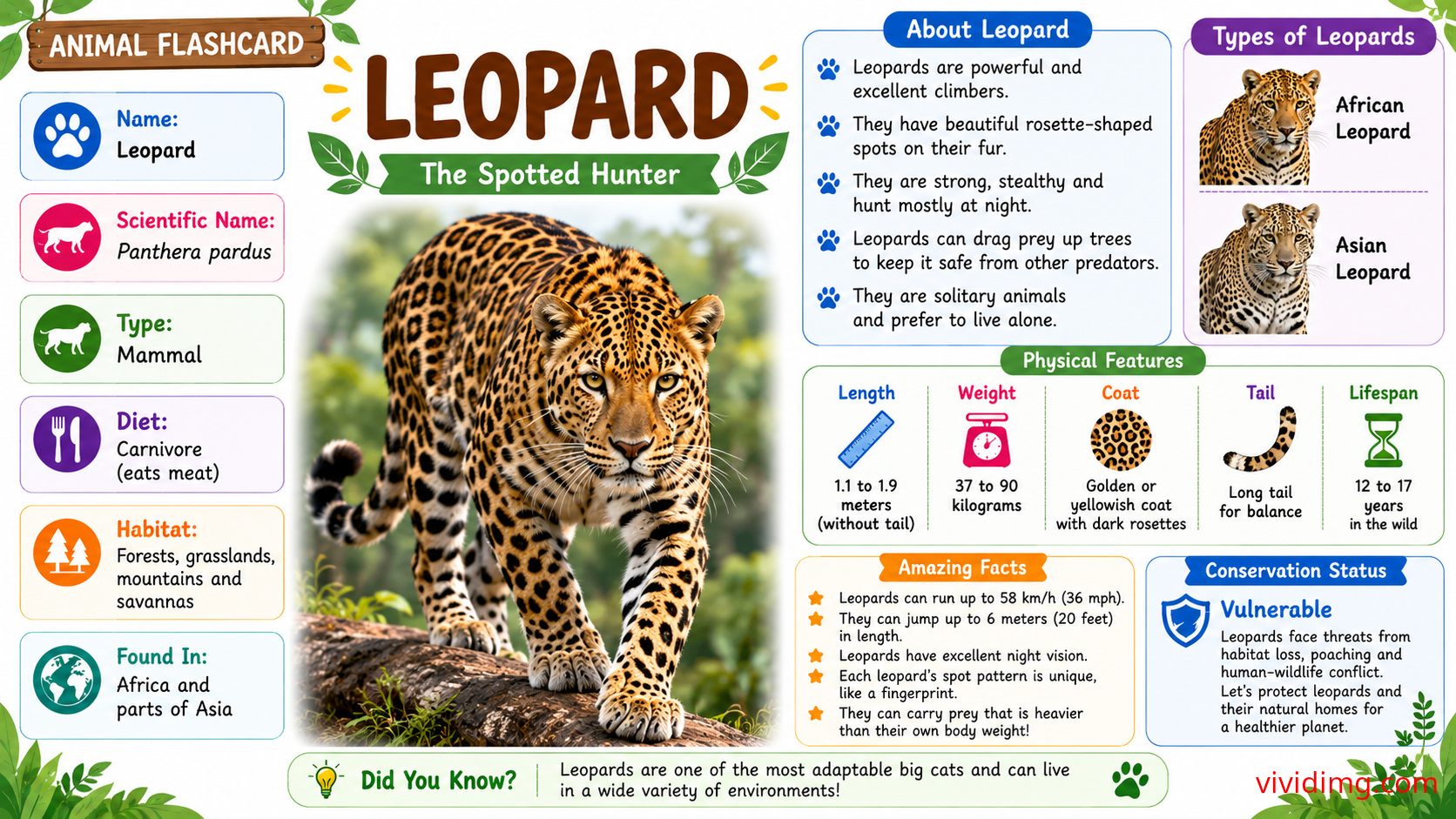
Leopard facts for kids - Animal flashcard
Explore the fascinating world of leopards with this detailed educational animal flashcard designed for children, students, teachers, and wildlife enthusiasts. The leopard (Panthera pardus) is one of the most adaptable and widespread big cats in the world. Recognized by its beautiful golden coat covered with dark rosette-shaped spots, the leopard is an expert hunter and an excellent climber. It belongs to the mammal family and is a carnivore, feeding on a wide variety of animals including deer, antelope, monkeys, wild boars, birds, and smaller mammals. Leopards are found across many parts of Africa and Asia, where they successfully inhabit forests, grasslands, mountains, deserts, woodlands, and rocky landscapes. Their remarkable ability to survive in such diverse environments makes them one of nature's most versatile predators. This flashcard introduces children to the leopard's appearance, classification, habitat, diet, behavior, and incredible survival skills through an engaging and easy-to-understand format.
Unlike lions, which live in prides, or cheetahs that depend on speed, leopards prefer a solitary lifestyle and rely on stealth and patience while hunting. They usually become active during the evening and nighttime, quietly stalking prey before launching a sudden attack. One of the leopard's most impressive abilities is its strength. A leopard can drag prey weighing more than its own body weight high into a tree to protect it from scavengers such as lions and hyenas. Their muscular bodies, powerful jaws, sharp claws, excellent hearing, and exceptional night vision make them highly successful hunters. Every leopard has a unique pattern of rosettes on its coat, allowing researchers to identify individual animals in the wild, much like fingerprints identify humans. Their long tails also help maintain balance while climbing trees, running, or moving across rocky terrain.
There are several recognized leopard subspecies, including the African leopard, Indian leopard, Persian leopard, Arabian leopard, Amur leopard, Javan leopard, Sri Lankan leopard, and Indochinese leopard. Each subspecies has adapted to different climates and habitats across its geographical range. Leopards are incredibly agile animals and can leap several meters in a single jump, climb tall trees with ease, and swim when necessary. Female leopards usually raise one to three cubs, teaching them essential hunting and survival skills until they become independent. Cubs stay hidden during their early months for protection and gradually learn how to stalk prey by observing their mother. These remarkable behaviors make leopards one of the most intelligent and resourceful members of the cat family, providing children with valuable lessons about adaptation, survival, and biodiversity.
Despite their remarkable adaptability, leopard populations face numerous threats across their natural range. Habitat destruction, deforestation, illegal hunting, human-wildlife conflict, and the decline of natural prey have affected many leopard populations. Some subspecies, such as the Amur leopard, are critically endangered and require intensive conservation efforts to prevent extinction. Wildlife reserves, national parks, habitat restoration, anti-poaching programs, and community conservation initiatives all contribute to protecting these magnificent cats. This educational leopard flashcard is perfect for preschool and kindergarten activities, primary school science lessons, homeschooling, wildlife education, classroom projects, African and Asian animal studies, and general knowledge learning. With realistic imagery, organized facts, physical characteristics, behavioral information, habitat details, conservation awareness, and interesting trivia, this flashcard helps children develop curiosity about wildlife while encouraging appreciation for one of the world's most graceful and powerful big cats.