Shareable Image
Cheetah facts for kids - Animal flashcard
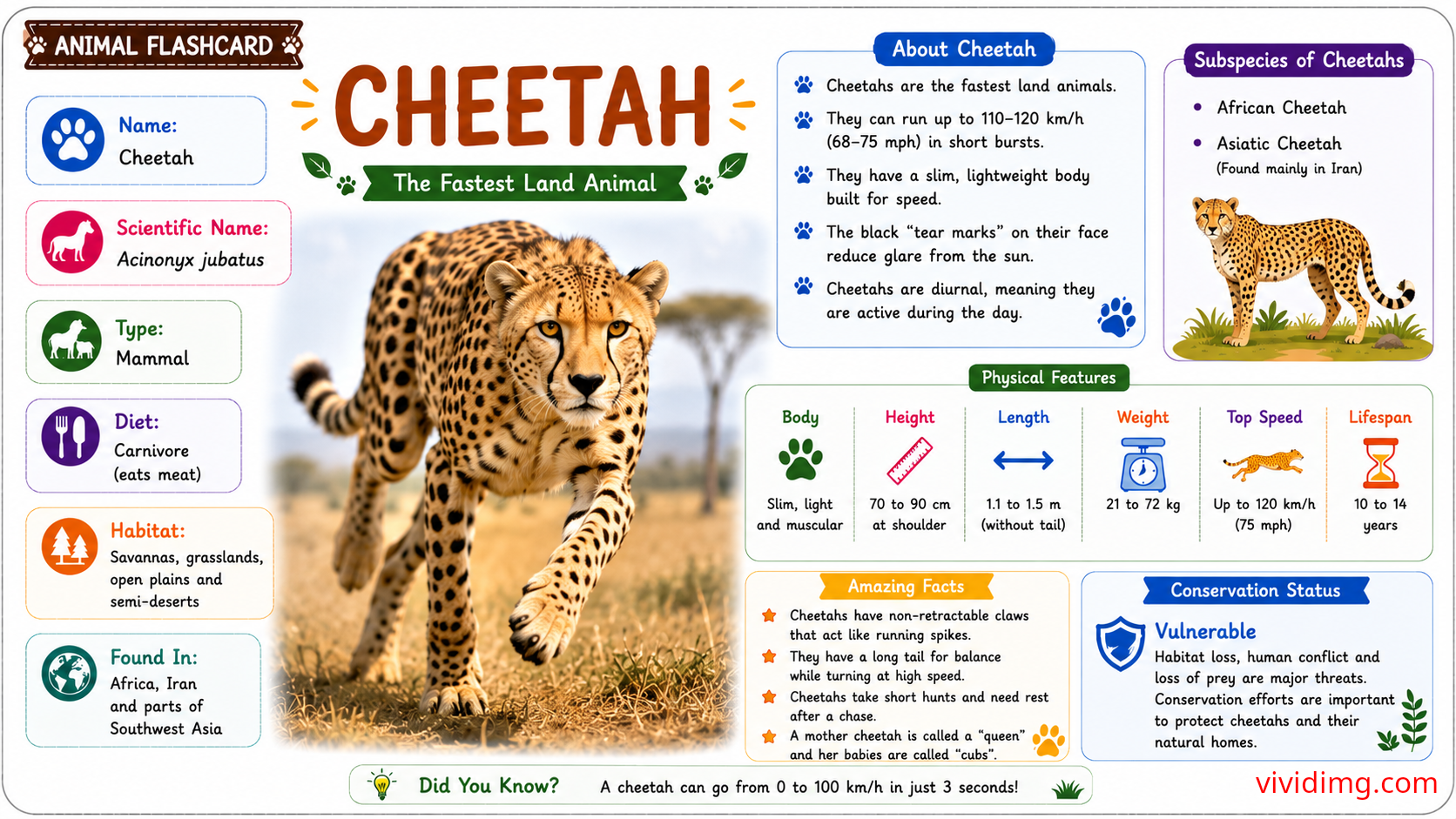
Discover the incredible cheetah with this colorful educational animal flashcard designed to help children learn about one of nature's most remarkable predators. The cheetah, scientifically known as Acinonyx jubatus, is a carnivorous mammal famous for being the fastest land animal in the world. Its body is specially designed for rapid acceleration and short bursts of extraordinary speed. Cheetahs live mainly in parts of Africa, with a critically endangered Asiatic cheetah population surviving in Iran. They prefer open environments such as savannas, grasslands, dry forests, scrublands, and semi-desert regions where their speed can be used effectively while hunting. Unlike heavier big cats, the cheetah has a slender body, long legs, a relatively small head, deep chest, flexible spine, and lightweight frame. These characteristics work together to create an animal perfectly adapted for high-speed pursuit.
A cheetah can reach extraordinary speeds during a chase, although it can maintain its highest speeds only for a short distance. Its flexible spine stretches and contracts dramatically while running, helping increase the length of each stride. The cheetah's claws are less retractile than those of most other cats, providing additional grip while accelerating and changing direction. Its long tail acts like a counterbalance and helps stabilize the body during rapid turns. Another easily recognizable feature is the pair of dark lines running from the inner corners of the eyes toward the mouth. These markings are commonly called tear marks and may help reduce glare while the animal is hunting during daylight. Cheetahs generally rely on excellent eyesight to locate prey and then approach carefully before beginning a high-speed chase. Their prey commonly includes smaller and medium-sized antelopes and other animals that can be captured during a short pursuit.
Cheetahs also have interesting social behavior. Females generally live independently except when raising cubs, while male cheetahs may live alone or form small groups called coalitions, often with their brothers. A mother cheetah must protect and teach her cubs until they are capable of surviving independently. Young cubs are particularly vulnerable to predators, making their early months challenging in the wild. Unlike lions, cheetahs cannot produce a deep, powerful roar. Instead, they communicate using several other sounds, including chirps, purrs, growls, hisses, and calls between mothers and cubs. After an intense chase, a cheetah usually needs time to recover because sprinting at such high speed requires enormous physical effort. This combination of specialized anatomy, hunting strategy, communication, and social behavior makes the cheetah an excellent animal for introducing children to concepts such as adaptation, speed, predators, food chains, and survival.
Cheetahs face significant conservation challenges despite their extraordinary abilities. The species is classified as Vulnerable on the IUCN Red List, while some populations are at considerably greater risk. Habitat loss and fragmentation, declining prey populations, conflict with humans, illegal wildlife trade, and low genetic diversity are among the challenges affecting cheetahs. The Asiatic cheetah is especially rare and survives only in Iran. Protecting large connected habitats is particularly important because cheetahs can travel across extensive territories. This educational cheetah flashcard combines realistic imagery with information about speed, anatomy, diet, habitat, hunting, behavior, distribution, and conservation. It is ideal for preschool and kindergarten activities, primary school science lessons, homeschooling, classroom wildlife projects, African animal studies, general knowledge activities, and printable educational collections. Children can use the flashcard not only to recognize a cheetah but also to understand how its remarkable body has evolved for speed and why protecting this unique species and its natural habitat is important.