Shareable Image
Life cycle of a spider – from egg sac to adult spider
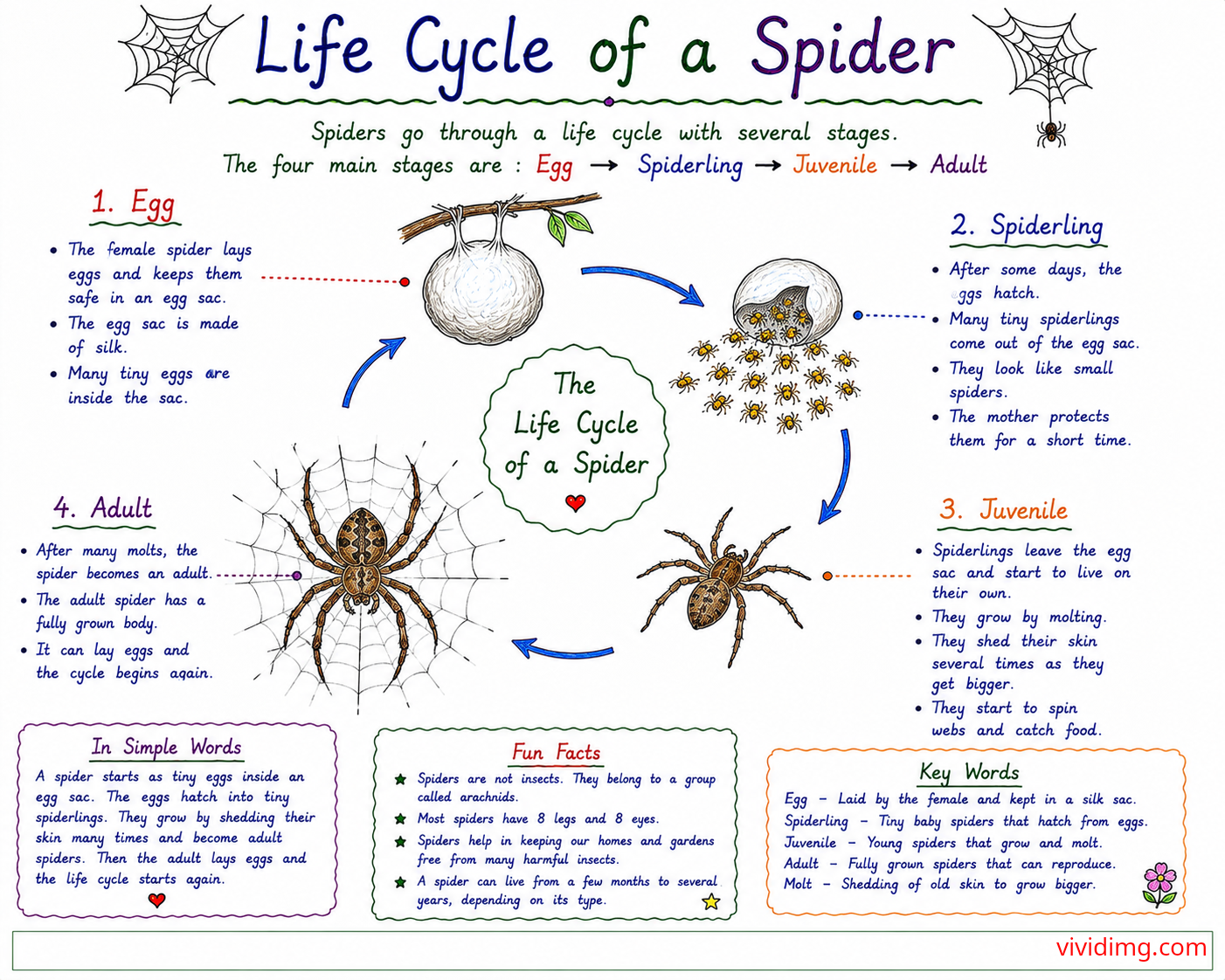
The life cycle of a spider is a fascinating natural process that shows how a tiny spider develops from an egg into a fully grown adult. Unlike insects such as butterflies, spiders do not pass through a pupal stage. Instead, they gradually grow through several stages while repeatedly shedding their outer covering. This handwritten educational diagram explains the spider life cycle through four easy-to-follow stages: egg, spiderling, juvenile, and adult.
The journey begins with the egg stage . A female spider lays many tiny eggs and usually protects them inside an egg sac made from silk. Depending on the spider species, the egg sac may be attached to a web or plant, hidden in a protected location, or carried by the female. The silk covering helps protect the developing eggs until they are ready to hatch.
When the eggs hatch, tiny young spiders called spiderlings emerge from the egg sac. Spiderlings resemble miniature versions of adult spiders, although their bodies are still developing. As they begin living independently, they search for food and safe places to grow.
The next stage is the juvenile spider . Because a spider's outer covering cannot expand continuously as its body grows, the young spider must shed it through a process called molting. Juvenile spiders molt several times as they become larger and develop the characteristics of mature spiders.
After completing its growth, the spider reaches the adult stage . A mature spider has a fully developed body and can reproduce. Adult females can eventually lay eggs, beginning a new generation and continuing the life cycle.
The handwritten chart presents these stages in a circular flow with illustrations of an egg sac, newly hatched spiderlings, a juvenile spider, and an adult spider on its web. Simple explanations, keywords, and interesting spider facts make the diagram especially useful for young learners.
This educational spider life cycle chart is ideal for biology lessons, science projects, classroom activities, homeschooling, nature studies, school assignments, and educational displays. It also helps students learn an important biological distinction: spiders are arachnids rather than insects. Understanding their development encourages children to explore biodiversity and appreciate the important role spiders play in natural ecosystems by feeding on many insects and other small organisms.