Shareable Image
Zebra facts for kids - Animal flashcard
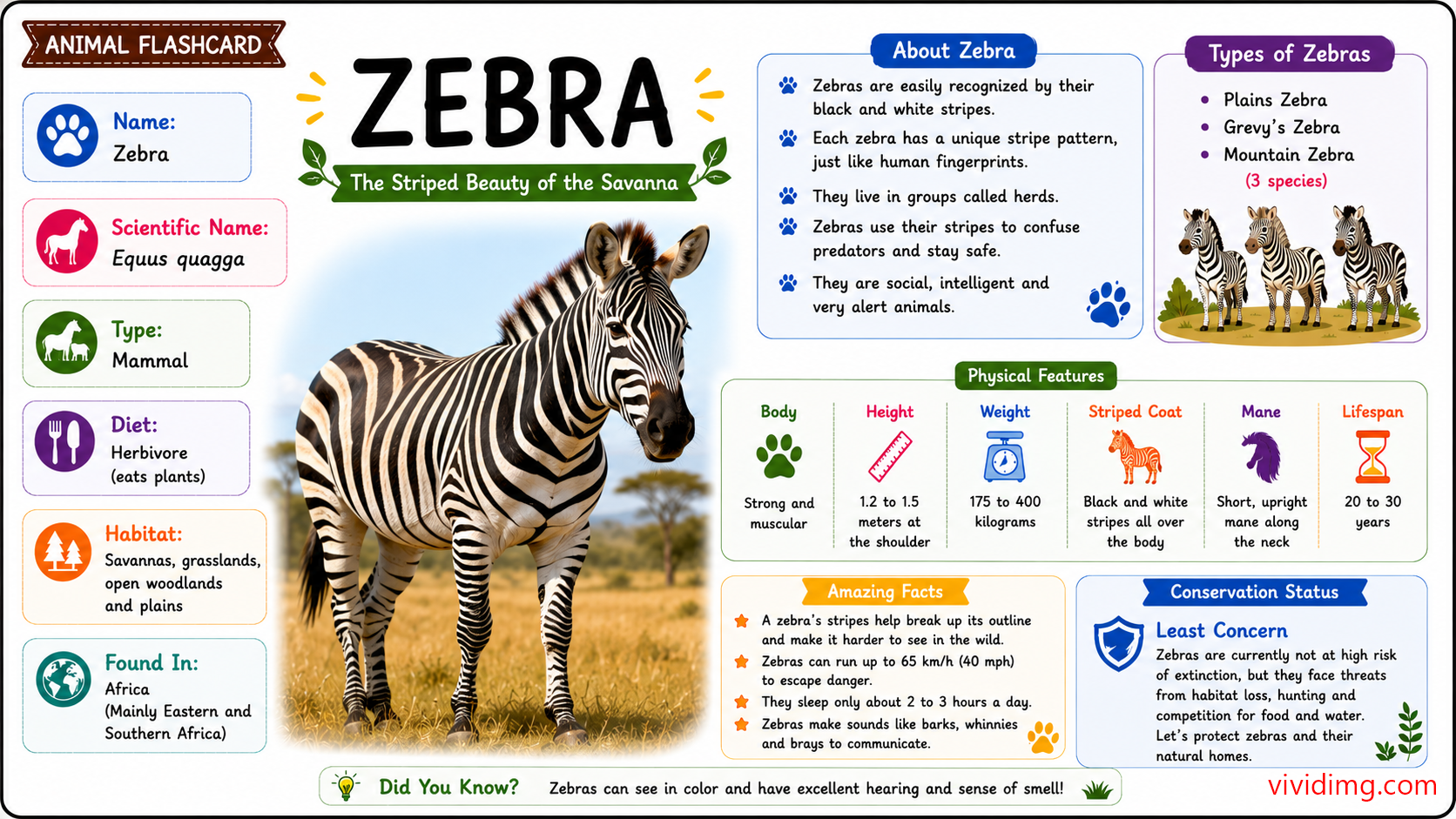
Discover the fascinating world of zebras with this educational animal flashcard created for children who enjoy learning about wildlife and nature. Zebras are African mammals famous for the striking black-and-white stripes covering their bodies. They belong to the horse family, Equidae, and are closely related to horses and donkeys. Zebras are herbivores and spend much of their time feeding on grasses, although they may also eat leaves, shoots, bark, and other vegetation when necessary. They naturally inhabit several environments across eastern and southern Africa, including savannas, open grasslands, plains, shrublands, and mountainous regions. Their strong legs and sturdy bodies are well adapted for travelling across these landscapes while searching for fresh grazing areas and water. This flashcard combines a realistic zebra image with clearly organized information about its classification, diet, habitat, distribution, physical characteristics, behavior, and remarkable adaptations.
One of the most interesting things about a zebra is its striped coat. Every zebra develops an individual stripe pattern, meaning no two animals have exactly the same arrangement of stripes. Scientists continue to study the different functions of zebra stripes, with evidence suggesting that they can help reduce biting-fly attacks and may also play roles in recognition and visual effects when zebras gather together. Zebras have excellent senses that help them remain aware of their surroundings. Their large ears can rotate to detect sounds coming from different directions, while their eyes are positioned to provide a broad field of vision. Strong legs allow zebras to run quickly when escaping predators, and their powerful kicks can provide an effective form of defense. Zebras also have upright manes running along their necks and strong teeth adapted for grazing tough vegetation. Depending on the species, adults vary considerably in height and weight, with Grévy's zebra generally being the largest of the living zebra species.
There are three living zebra species: the plains zebra, mountain zebra, and Grévy's zebra. The plains zebra is the most widespread and is commonly associated with the vast grasslands and savannas of eastern and southern Africa. Mountain zebras inhabit more rugged and mountainous environments in southwestern Africa, while Grévy's zebras occur primarily in parts of Kenya and Ethiopia and can be recognized by their narrow stripes and large rounded ears. Zebras are social animals, although their social organization differs between species. Plains and mountain zebras commonly form stable family groups, while Grévy's zebras have a more flexible social system. Zebras communicate through vocalizations such as barks, brays, snorts, and squeals as well as facial expressions, ear positions, and other body movements. Mothers develop close relationships with their young, which are called foals. A newborn foal can stand relatively soon after birth and begins following its mother as it learns how to survive within its environment.
Zebras are also an excellent subject for introducing children to biodiversity and wildlife conservation because the three species do not share the same conservation status. The plains zebra is currently classified as Near Threatened by the IUCN, the mountain zebra as Vulnerable, and Grévy's zebra as Endangered. Habitat changes, competition with livestock, hunting, reduced access to water, and other human pressures can affect different zebra populations. Learning these differences teaches children an important lesson: animals that look similar can belong to different species and face very different challenges in the wild. This zebra flashcard is suitable for preschool and kindergarten activities, primary school science lessons, homeschooling, classroom projects, African animal studies, wildlife identification exercises, and general knowledge practice. By combining realistic imagery with information about zebra species, stripes, diet, habitat, social life, physical adaptations, communication, and conservation, this educational resource provides young learners with an engaging introduction to one of Africa's most distinctive animals.