Shareable Image
Giraffe facts for kids - Animal flashcard
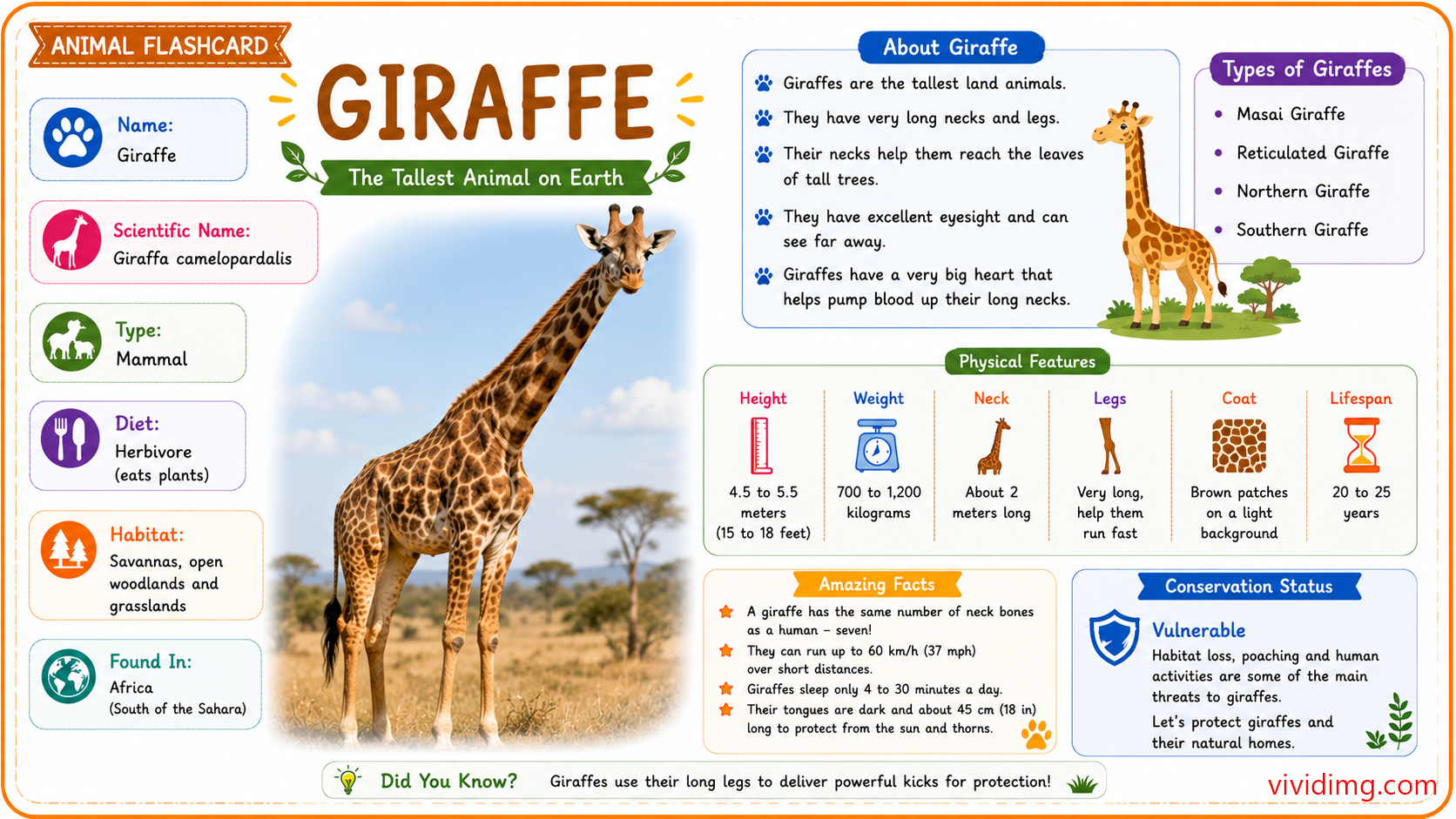
Discover the amazing world of giraffes with this colorful educational animal flashcard designed for children who love animals, nature, and wildlife. Giraffes are instantly recognizable because of their extraordinarily long necks, tall legs, patterned coats, and impressive height. They are the tallest living land animals, with adult males capable of reaching heights of more than 5 meters. Giraffes are mammals and herbivores, feeding mainly on leaves, shoots, flowers, and other plant material. Their height gives them access to vegetation that many other plant-eating animals cannot easily reach. Giraffes live naturally in different parts of Africa, especially in savannas, open woodlands, shrublands, and grasslands where suitable trees and plants are available. This educational flashcard introduces young learners to the giraffe's classification, diet, habitat, distribution, appearance, physical characteristics, behavior, and conservation through an engaging combination of realistic imagery and easy-to-understand facts.
The giraffe's long neck is one of the most fascinating adaptations in the animal kingdom. Despite being dramatically longer than a human neck, a giraffe usually has the same number of cervical vertebrae as humans: seven. Each vertebra is simply much larger and longer. Giraffes also have long, strong legs that allow them to walk efficiently across open landscapes and run surprisingly fast when necessary. Their distinctive coat consists of darker patches separated by lighter lines, and the exact pattern varies among individuals. These patterns can help researchers identify individual giraffes. On top of the head are horn-like structures called ossicones, which are present in both males and females. Another remarkable adaptation is the giraffe's long, muscular tongue, which can help it grasp leaves and feed among thorny branches. Its cardiovascular system is also specially adapted to move blood through such a tall body, including maintaining circulation between the heart and brain as the giraffe raises and lowers its head.
Giraffes are social animals, although their groups are generally flexible and can change frequently as individuals join or leave. Females may be seen together with their calves, while adult males can travel independently or associate with other males. A newborn giraffe is called a calf and is already remarkably tall at birth. Young giraffes must quickly learn to stand, walk, follow their mothers, and remain alert to predators. Giraffes rely heavily on their excellent eyesight and height to observe their surroundings. Their powerful legs can also provide an important defense against predators such as lions. Modern scientific classifications recognize four giraffe species in some taxonomic frameworks: the northern giraffe, southern giraffe, Masai giraffe, and reticulated giraffe, although giraffe taxonomy continues to be studied and different authorities may classify populations differently. Their coat patterns, geographic ranges, and some physical characteristics can help distinguish different giraffe populations.
Giraffes also provide an important introduction to wildlife conservation. The IUCN currently lists the giraffe overall as Vulnerable, although the conservation situation differs considerably among populations and subspecies. Habitat loss and fragmentation, changes in land use, illegal hunting, and other human pressures have affected giraffes in several regions. Protecting suitable habitats and maintaining connected landscapes are important for their long-term survival. This giraffe flashcard can therefore help children learn not only what a giraffe looks like but also how its body is adapted to its environment and why protecting wildlife matters. It is suitable for preschool and kindergarten activities, primary school science lessons, homeschooling, classroom projects, animal identification exercises, African wildlife studies, general knowledge practice, and printable educational collections. With a realistic giraffe image, clearly organized facts, physical measurements, behavioral information, interesting adaptations, and conservation awareness, this flashcard offers young learners an engaging introduction to one of Africa's most extraordinary animals.