Shareable Image
Elephant facts for kids - Animal flashcard
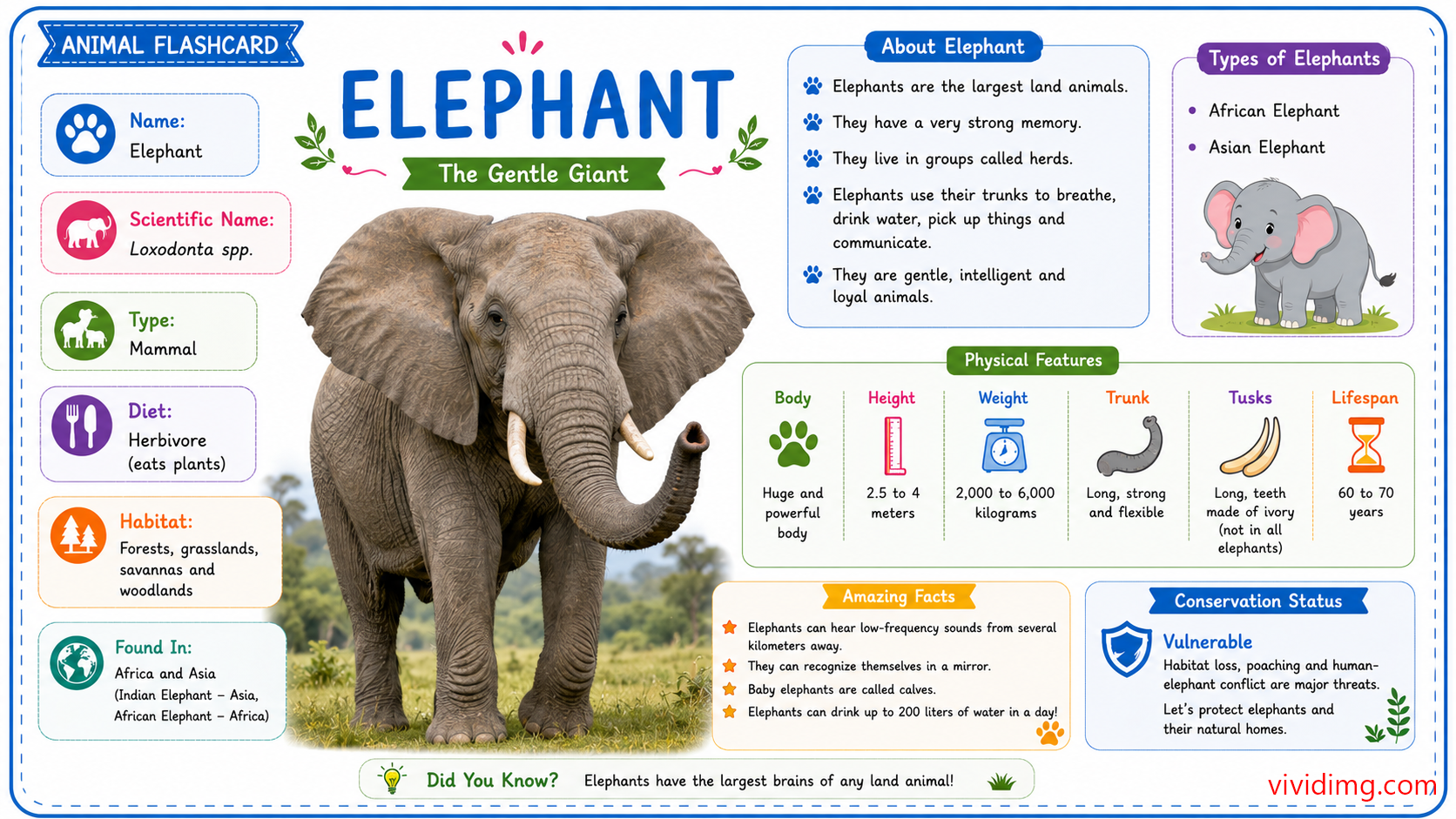
Discover the incredible world of elephants with this colorful educational animal flashcard created for children, students, teachers, and young wildlife enthusiasts. Elephants are the largest living land animals and are famous for their enormous bodies, long trunks, large ears, thick legs, and remarkable intelligence. They are mammals and herbivores, feeding on grasses, leaves, bark, roots, fruits, and other plant material. Wild elephants occur naturally in parts of Africa and Asia, where they inhabit environments such as savannas, forests, grasslands, wetlands, and woodlands. Their size and appearance make them easy for children to recognize, while their complex behavior makes them one of the most fascinating animals to study. This flashcard brings together essential information about elephant classification, food, habitat, distribution, physical characteristics, behavior, and conservation in an easy-to-understand visual format.
One of the elephant's most extraordinary features is its trunk. This highly flexible organ combines the functions of the nose and upper lip and contains tens of thousands of muscles and muscle units. Elephants use their trunks for breathing, smelling, touching, communicating, collecting food, drinking, spraying water, and manipulating objects. Their tusks are enlarged incisor teeth that can be used for digging, stripping bark, moving objects, defense, and other activities. However, not every elephant develops prominent tusks. Elephants also have large and complex brains and demonstrate impressive learning, memory, communication, cooperation, and problem-solving abilities. They can communicate using sounds that include very low-frequency calls capable of travelling over considerable distances. Their sensitive feet and bodies can also detect vibrations moving through the ground. These remarkable abilities allow elephants to stay connected with other members of their herd even across large areas.
Elephants are highly social animals. Females and their young commonly live in family groups led by an experienced older female called a matriarch. She can play an important role in guiding the herd toward food and water and responding to potential dangers. Baby elephants are called calves and depend on their mothers and other members of the family group while growing and learning. Adult males generally become more independent as they mature and may live alone or associate with other males. Three living elephant species are recognized: the African savanna elephant, African forest elephant, and Asian elephant. These species differ in characteristics such as body size, ear shape, habitat, geographic distribution, and other anatomical features. African savanna elephants are generally the largest, while Asian elephants typically have smaller ears and different head and trunk characteristics. Elephants can live for many decades, giving them time to develop strong social relationships and accumulate knowledge about their environment.
Elephants are also important ecosystem engineers because their everyday activities can significantly influence the landscapes around them. By feeding on vegetation, creating pathways, digging for water, dispersing seeds through their dung, and modifying trees and shrubs, elephants can affect habitats used by many other organisms. Unfortunately, elephant populations face serious conservation challenges. Habitat destruction and fragmentation, human-elephant conflict, and illegal killing for ivory continue to threaten different populations. Conservation status also differs among species: the African savanna elephant is classified as Endangered, while the African forest elephant is Critically Endangered, and the Asian elephant is Endangered on the IUCN Red List. This educational elephant flashcard therefore provides more than basic animal identification. It can introduce children to biology, habitats, animal behavior, ecosystems, and wildlife conservation at the same time. It is suitable for preschool and kindergarten learning, primary school science lessons, homeschooling, classroom projects, wildlife activities, general knowledge practice, and printable educational collections. With realistic imagery and clearly organized facts, children can learn why elephants truly deserve their reputation as intelligent, powerful, social, and extraordinary giants of the animal kingdom.