Shareable Image
Water cycle – understanding how water moves around the Earth
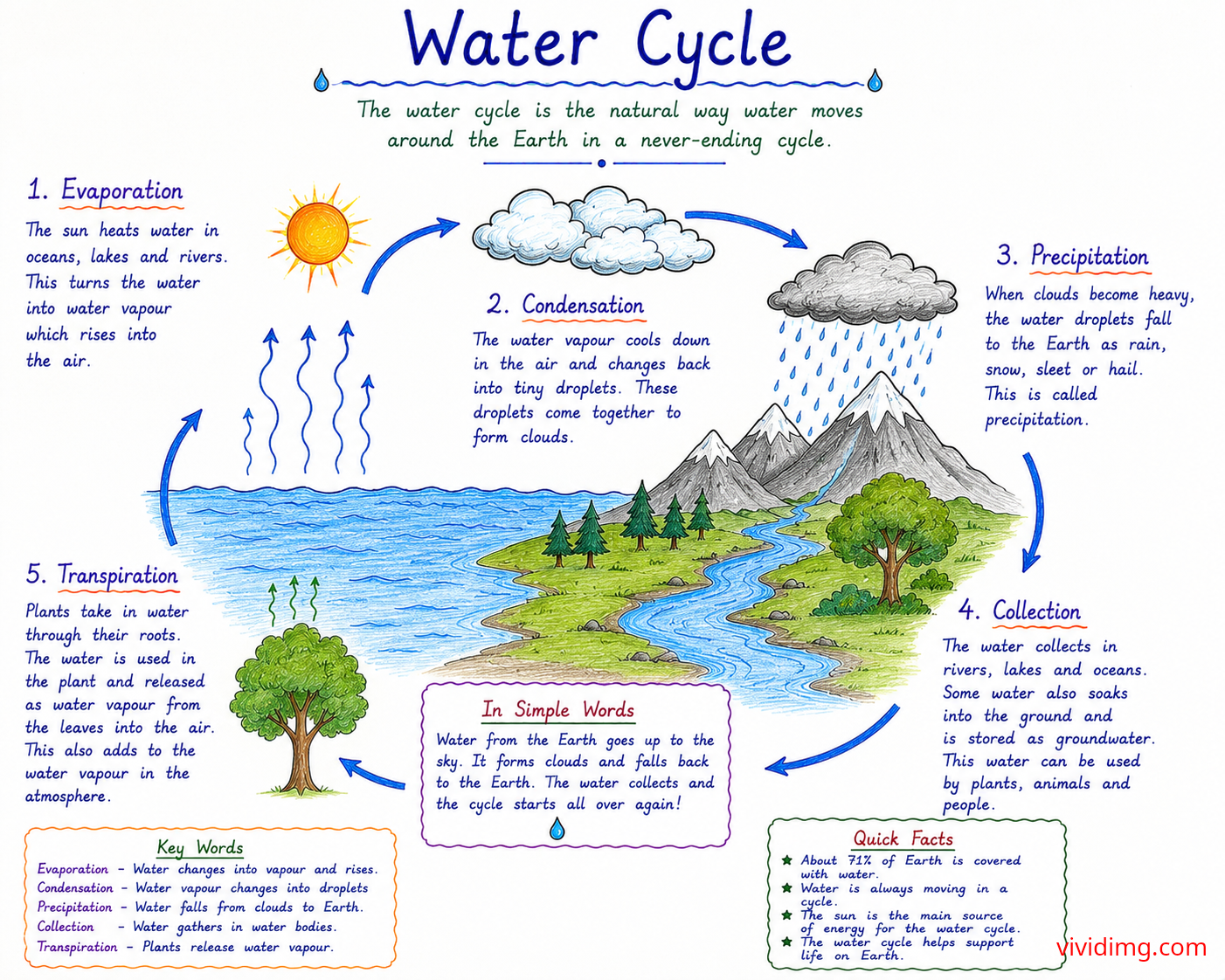
The water cycle is one of Earth's most important natural processes, continuously moving water between the land, oceans, atmosphere, and living organisms. This handwritten educational diagram explains the water cycle through five important stages: evaporation, condensation, precipitation, collection, and transpiration. The colorful illustrations, directional arrows, and simple explanations make the process easy for students to understand and remember.
The cycle begins with evaporation . Heat from the Sun warms water in oceans, lakes, rivers, and other water bodies, causing some of it to change into water vapor and rise into the atmosphere. As the water vapor travels higher, it reaches cooler air and begins the process of condensation . The vapor changes back into tiny water droplets, which gather together to form clouds.
When enough water droplets accumulate inside the clouds, they become heavy and return to Earth through precipitation . Depending on atmospheric conditions, precipitation can occur as rain, snow, sleet, or hail. The falling water eventually reaches rivers, lakes, oceans, and the ground, beginning the collection stage. Some water also soaks into the soil and becomes groundwater that can later be used by plants, animals, and people.
Plants also contribute to the water cycle through transpiration . They absorb water through their roots and release some of it as water vapor through their leaves. This vapor returns to the atmosphere and eventually becomes part of the cycle again.
The illustration connects all these stages with arrows around a landscape featuring the Sun, clouds, mountains, rainfall, rivers, oceans, and plants. It also includes simple explanations, keywords, and quick facts that help children understand how the individual stages work together as one continuous natural cycle.
This handwritten water cycle chart is ideal for science lessons, geography classes, environmental studies, school projects, classroom displays, homeschooling, and revision activities. It gives learners a visual way to understand where rain comes from, how clouds form, why evaporation happens, and how Earth's water is continuously recycled. Learning about the water cycle also helps students understand the relationship between weather, climate, plants, freshwater resources, and life on Earth.