Shareable Image
Layers of the Earth – understanding Earth's internal structure
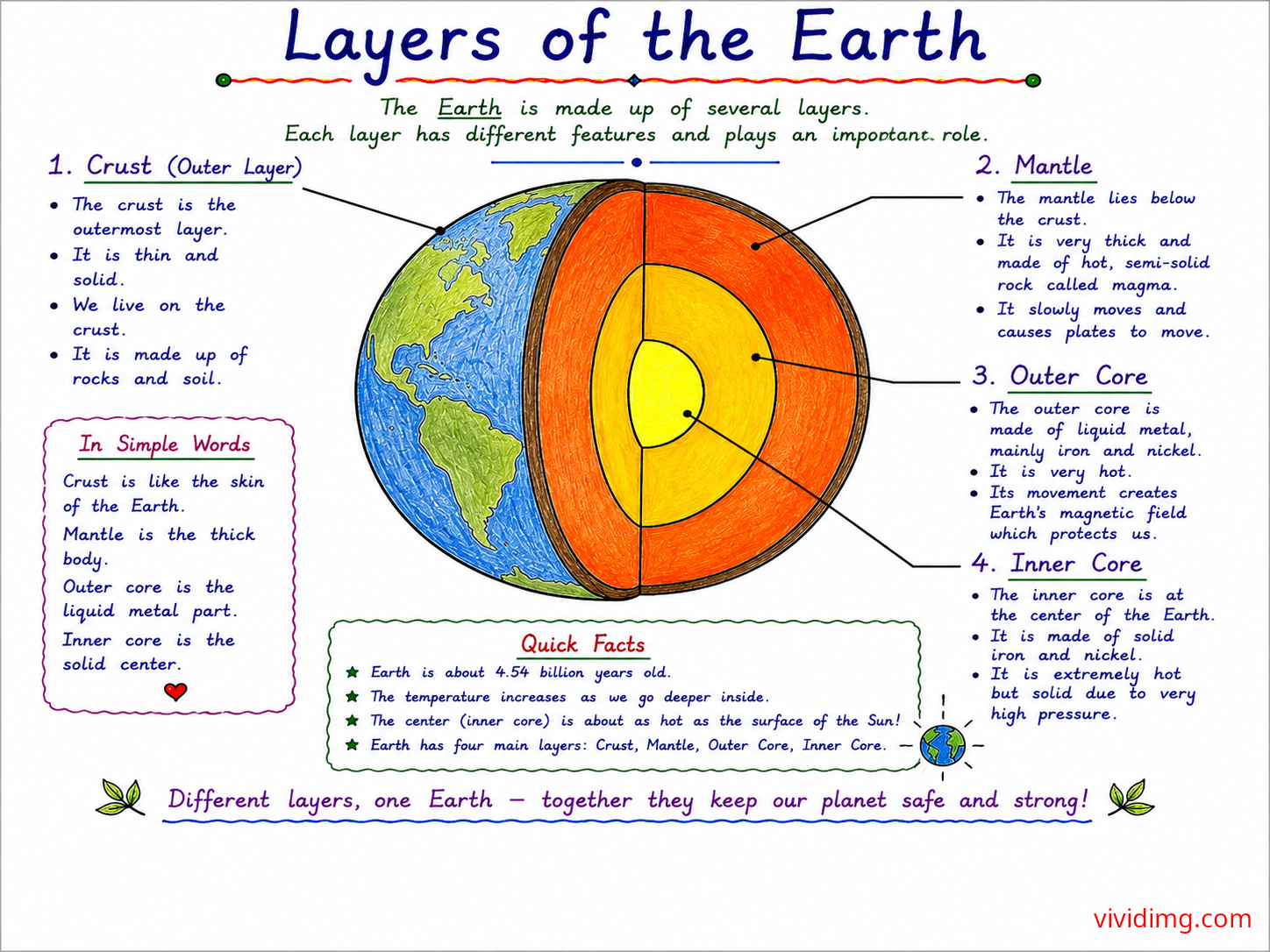
The Earth is made up of several distinct layers, each with unique characteristics that help shape our planet. From the thin outer crust where we live to the extremely hot inner core deep beneath the surface, every layer plays an important role in Earth's structure, geological activity, and magnetic field. This handwritten educational diagram presents the layers of the Earth in a simple, colorful, and easy-to-understand format, making it an excellent learning resource for students, teachers, and parents.
The outermost layer is the crust , a thin and solid shell made of rocks and soil. It is the layer where humans, animals, and plants live. Beneath the crust lies the mantle , the thickest layer of the Earth. The mantle consists of hot, semi-solid rock that slowly moves over time. These movements cause tectonic plates to shift, leading to earthquakes, volcanic eruptions, and the formation of mountains.
Below the mantle is the outer core , a layer composed mainly of molten iron and nickel. The movement of these liquid metals generates Earth's magnetic field, which protects the planet from harmful solar radiation. At the very center is the inner core , a solid sphere of iron and nickel. Although it is one of the hottest parts of the Earth, the immense pressure keeps it in a solid state.
Learning about the Earth's layers helps students understand many important scientific concepts, including plate tectonics, volcanoes, earthquakes, the rock cycle, and the planet's magnetic field. It also provides a strong foundation for geography, geology, environmental science, and Earth science education.
This handwritten educational chart is ideal for science classrooms, geography lessons, school assignments, homeschooling, educational displays, and project work. Its colorful illustrations and clearly labeled sections make complex concepts easy to understand while encouraging curiosity about the fascinating world beneath our feet.