Shareable Image
Jaguar facts for kids - Animal flashcard
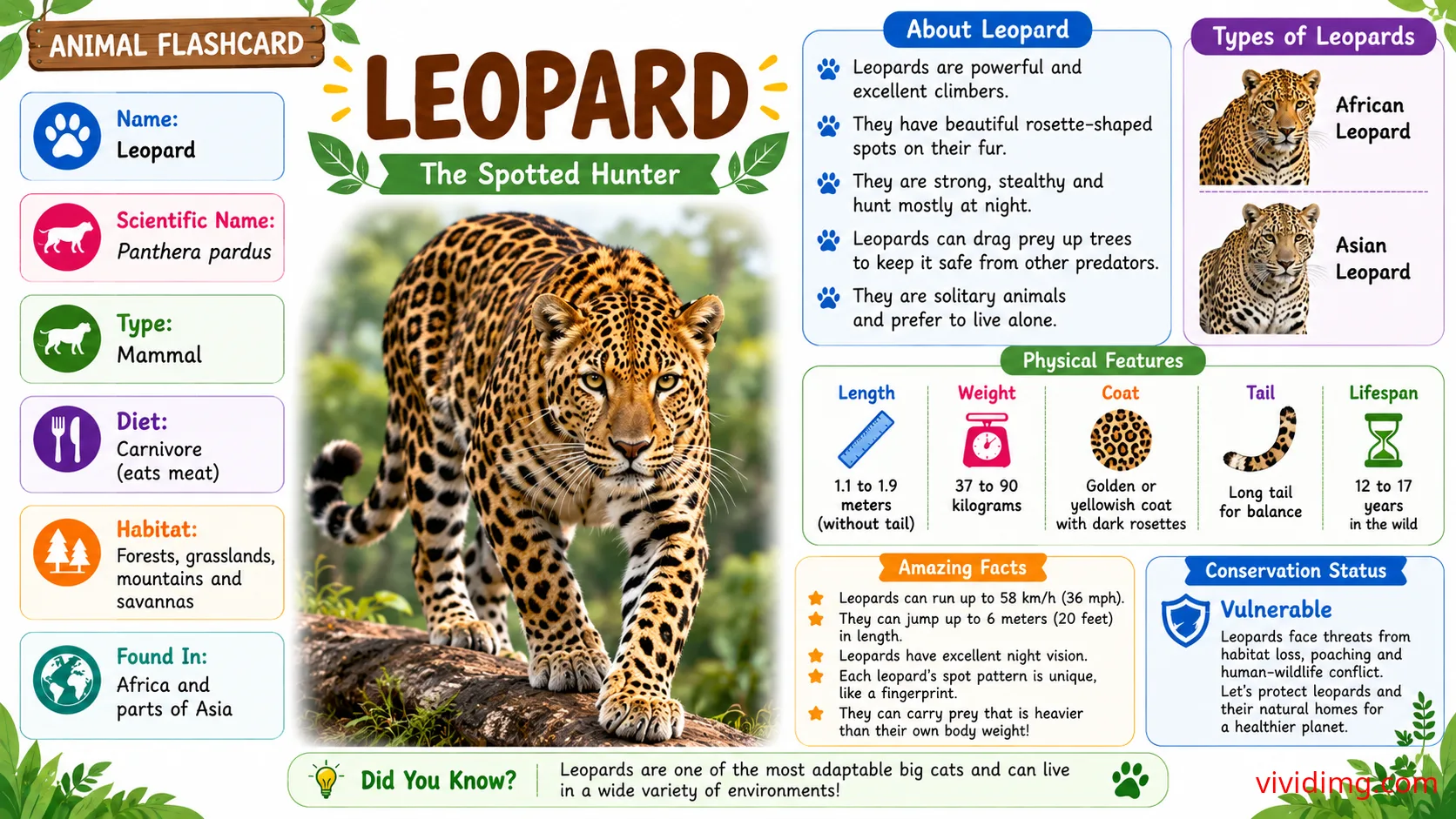
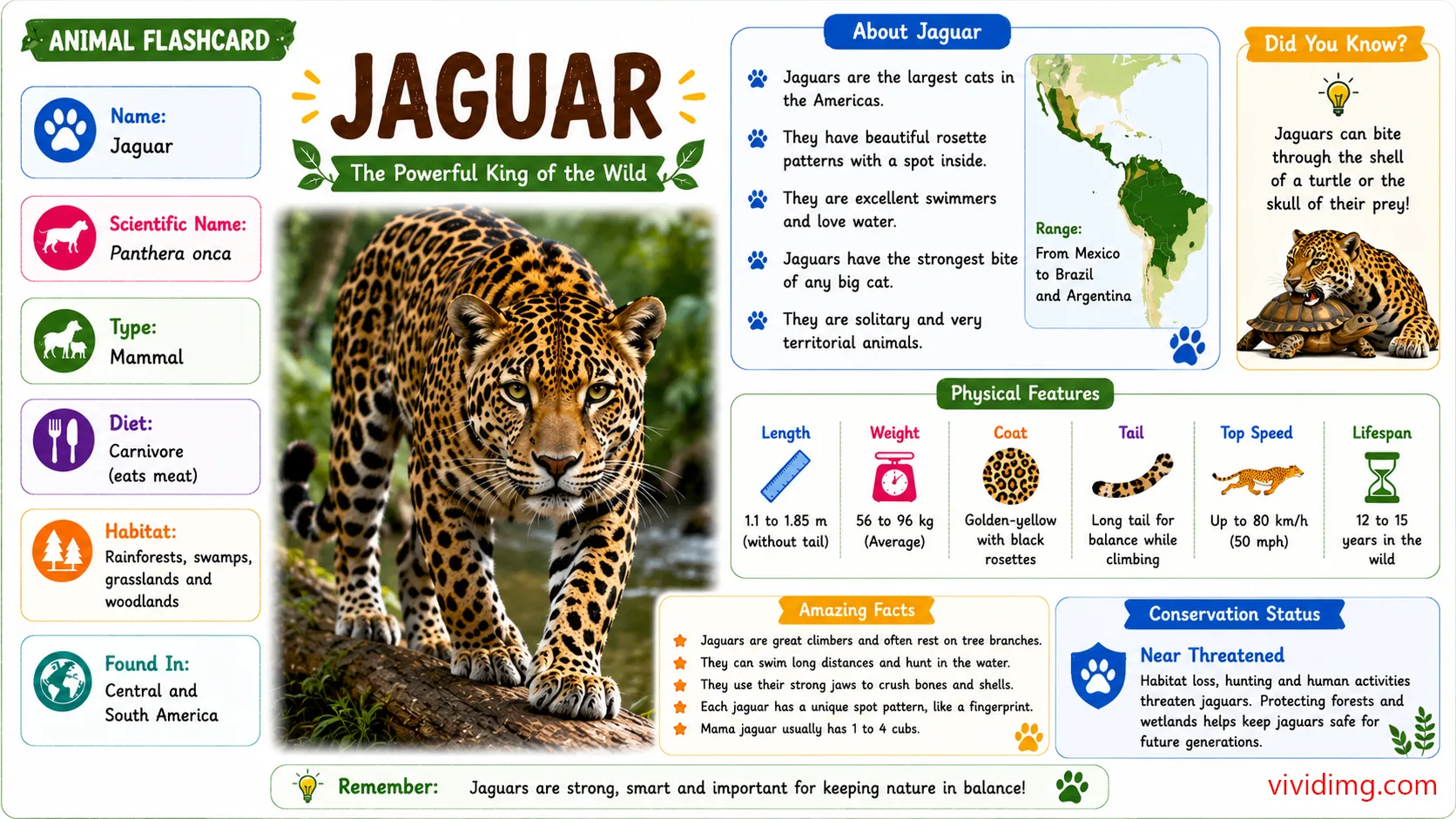
Discover the fascinating world of the jaguar with this educational animal flashcard specially designed for children, students, teachers, and wildlife enthusiasts. The jaguar (Panthera onca) is the largest wild cat in the Americas and the third-largest big cat in the world after the tiger and the lion. It is a powerful carnivorous mammal that belongs to the family Felidae. Jaguars are easily recognized by their beautiful golden-yellow coats covered with black rosette-shaped spots. Unlike the leopard, each rosette often contains one or more small black dots in the center, making it easier to distinguish between the two species. Jaguars naturally inhabit tropical rainforests, wetlands, grasslands, woodlands, and river systems from Mexico through Central America and much of South America, with Brazil's Amazon rainforest being one of their most important strongholds. This educational flashcard introduces young learners to the jaguar's habitat, appearance, diet, physical adaptations, behavior, and ecological importance using realistic imagery and carefully organized facts.
The jaguar is famous for its incredible strength and is considered one of the most powerful predators relative to its size. It possesses the strongest bite force of any living big cat, allowing it to crush bones and even penetrate the hard shells of turtles and caimans. Unlike many other large cats that usually bite the neck of their prey, jaguars often deliver a powerful bite directly through the skull. Their muscular body, broad head, short but extremely strong jaws, and stocky legs make them perfectly adapted for this hunting strategy. Jaguars are also excellent swimmers and spend much more time in water than most other big cats. They frequently cross rivers, hunt fish, turtles, caimans, and aquatic animals, and can comfortably move through flooded forests. Their spotted coat provides outstanding camouflage among dense vegetation, helping them silently approach prey before launching a quick and powerful attack. Every jaguar has a unique rosette pattern, enabling wildlife researchers to identify individuals without disturbing them.
Jaguars are solitary and territorial animals that usually hunt alone. Adult males occupy large territories that may overlap with those of several females, while females establish smaller home ranges where they raise their cubs. Young cubs remain with their mother for nearly two years, learning hunting techniques, climbing skills, swimming, and survival strategies before becoming independent. Jaguars communicate through scent marking, claw marks on trees, vocalizations, and deep roars that can travel through dense forests. Although they are capable climbers, jaguars spend much of their time on the ground or near water, unlike leopards that often rest high in trees. They are opportunistic hunters with a diet that includes deer, capybaras, peccaries, monkeys, birds, fish, turtles, caimans, and many other animals. Scientists have recorded jaguars feeding on more than 85 different prey species, demonstrating their remarkable adaptability across diverse ecosystems.
Despite being one of the world's most impressive predators, jaguar populations have declined across many parts of their historical range. The species is currently classified as Near Threatened by the International Union for Conservation of Nature (IUCN). Habitat destruction caused by deforestation, agricultural expansion, mining, road construction, illegal hunting, and conflicts with livestock farmers continue to reduce suitable habitat for jaguars. Conservation organizations work to protect forests, establish wildlife corridors, reduce human-wildlife conflict, and monitor wild populations using modern technologies such as camera traps and GPS tracking. This educational jaguar flashcard is an excellent learning resource for preschool and kindergarten activities, primary school science lessons, homeschooling, wildlife education, classroom projects, rainforest studies, South American wildlife lessons, and general knowledge learning. By combining realistic photography with engaging facts about anatomy, behavior, habitat, hunting techniques, conservation, and ecological importance, this flashcard encourages children to appreciate one of nature's most powerful and mysterious big cats while understanding why protecting biodiversity is essential for future generations.